
Wedding Checklist UK
Wedding checklist UK: a planning timeline with real dates
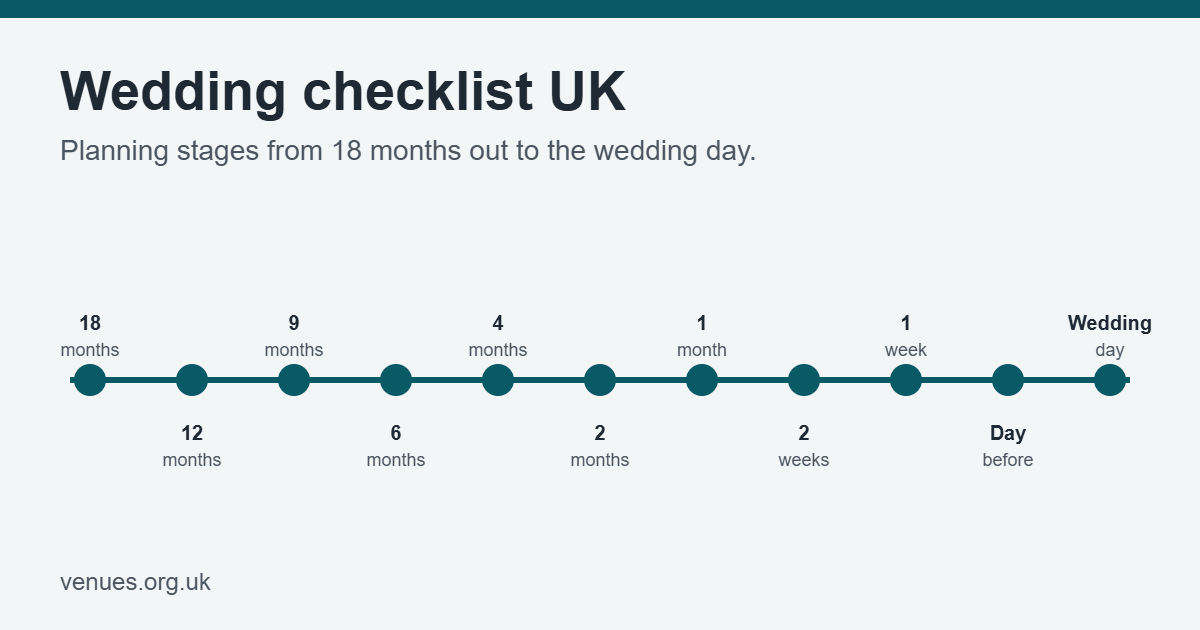
This is a wedding checklist UK couples can follow from 18 months before the wedding to the month after, with every main task in order. Enter your wedding date and each stage shows the real date to aim for. The legal steps follow GOV.UK guidance for England and Wales, checked in October 2026. Scotland and Northern Ireland have different legal rules, and there are links to them below.
Your ticks are not saved. They stay only while this page is open, so print the checklist or copy it as text to keep your progress.
Wedding planning checklist by stage
18 months or more before
12 months before
9 months before
6 months before
4 months before
2 months before
1 month before
2 weeks before
1 week before
The day before
On the day
In the month after
How the wedding timeline is worked out
Each stage date is your wedding date minus the time in the stage heading. Month stages count back whole calendar months, and the 2 week and 1 week stages count back 14 and 7 days. The stages are a common planning pattern, so move tasks earlier for a peak summer Saturday and later for a small wedding. A stage is flagged when its date is before today.
Worked example
For a wedding on Saturday 2 September 2028, the checklist shows these dates. The 12 month stage is Thursday 2 September 2027. The 6 month stage is Thursday 2 March 2028. Invitations, at 4 months, are due by Tuesday 2 May 2028. Final numbers go to the venue 2 weeks before, by Saturday 19 August 2028. The legal notice window runs from Thursday 2 September 2027 to Friday 4 August 2028. Once the earliest notice date has passed, the checklist tells you that you can give notice now.
Legal steps for a wedding in England and Wales
These points come from GOV.UK and were checked in October 2026. This is general information and not legal advice. Your register office or place of worship will confirm what applies to you.
- Who can marry. You can marry in England or Wales if you are 18 or over, not already married or in a civil partnership, and not closely related.
- Giving notice. You usually need to make an appointment to give notice at your local register office. You must have lived in that registration district for the past 7 days. If you and your partner live in different districts, you each give notice in your own district.
- Minimum notice period. You must give notice at least 29 days before your ceremony. GOV.UK gives the example that notice given on 1 May allows a ceremony from 30 May.
- How long notice is valid. You must hold your ceremony within 12 months of giving notice.
- If one of you is from outside the UK. GOV.UK says you must give notice together, at a register office in a district where at least one of you lives. Check the GOV.UK guidance early, because extra steps can apply.
- Approved premises. A civil ceremony can take place at a register office or at any venue approved by the local council, such as a stately home or hotel. Ask a venue whether it is approved, and for which rooms, before you confirm it for the ceremony.
- Civil ceremony content. You must have at least 2 witnesses. A civil ceremony can include readings, songs or music, but it cannot include anything religious, such as hymns or readings from the Bible or the Torah.
- Religious ceremonies. A religious wedding can take place at any registered religious building. An authorised person, such as a religious minister, must attend the ceremony. The process of giving notice might be different for Anglican weddings, so check with the church. Same-sex couples can marry in a religious building that is registered for the marriage of same-sex couples, but not in an Anglican church.
Sources: GOV.UK: marriages and civil partnerships in England and Wales (opens in a new tab), GOV.UK: give notice (opens in a new tab) and GOV.UK: plan your ceremony (opens in a new tab). You can find a register office on GOV.UK (opens in a new tab).
Scotland and Northern Ireland are different. The notice rules and the dates this checklist shows for legal tasks apply to England and Wales only. For a wedding planning timeline in the UK outside England and Wales, check the official guidance first: mygov.scot for Scotland (opens in a new tab) and nidirect for Northern Ireland (opens in a new tab).
Questions to ask a wedding venue before you commit
The venue is the biggest decision on any wedding to do list. Ask these questions on the visit and get the answers in writing.
- Is the date we want free, and how long will you hold it before we need to confirm?
- Is the venue approved for civil ceremonies, and in which rooms?
- How many guests can each room hold for the ceremony, the meal and the evening?
- What is included in the hire, and what is charged as an extra?
- What are the deposit, payment dates and cancellation terms?
- Do we have the whole venue, or will other events take place on the same day?
- From what time can we and our suppliers get in, and when must everything be cleared?
- Is catering in-house, from a set list of caterers, or our own choice?
- Can we bring our own drinks, and is there a charge for doing so?
- What time do the bar and the music finish, and is there a sound limit?
- What is the plan if it rains?
- Is there step-free access to every room we will use, and are there accessible toilets?
- How do you handle allergies and dietary needs?
- Are there rules on candles, confetti, fireworks or decorations?
- Is there parking, accommodation on site or nearby, and transport late at night?
- Who will be our contact in the months before, and who runs the day itself?
Wedding checklist UK questions
What should be on a wedding checklist in the UK?
A wedding checklist in the UK should cover the legal steps, the venue, suppliers, guests, outfits and the day itself. The checklist on this page has 77 tasks in 12 stages, from 18 months before the wedding to the month after. Enter your wedding date to see a real date for each stage.
How far in advance should you start planning a wedding?
This wedding planning checklist starts 18 months before the date, because the venue is usually the first thing couples confirm and the date depends on it. A shorter timeline is possible. Enter your date and the checklist flags the stages that have already passed so you can do those first.
How much notice do you have to give to get married in England and Wales?
GOV.UK says you must give notice at your local register office at least 29 days before your ceremony, and you must hold the ceremony within 12 months of giving notice. For a wedding on Saturday 2 September 2028, the checklist shows Friday 4 August 2028 as the last day to give notice and Thursday 2 September 2027 as the earliest.
What is the first thing to arrange for a wedding?
Confirm the venue first, because it fixes the date, the guest numbers and the type of ceremony you can have. Once the venue has held your date, book the registrar or speak to your place of worship, then the suppliers who can only do one wedding a day, such as the photographer.
When should wedding invitations be sent?
This wedding timeline puts save the dates at 12 months before and invitations at 4 months before, with a reply date that leaves time to give final numbers to the venue 2 weeks before. For a wedding on 2 September 2028, that means invitations by 2 May 2028.
Is the wedding checklist different in Scotland and Northern Ireland?
The planning tasks are the same, but the legal steps differ. The notice rules on this page apply to England and Wales. For a wedding in Scotland check mygov.scot, and for Northern Ireland check nidirect.gov.uk, before you set dates for the legal tasks.
Find a venue for your wedding
venues.org.uk is a directory of UK venues. You enquire with each venue directly.
Related tools
Use this wedding checklist to plan the venue first. You can browse wedding venues on venues.org.uk.