
Father of the Bride Speech
Father of the bride speech: structure, examples and a free speech builder
A father of the bride speech welcomes the guests, says something true about your daughter, welcomes her partner into the family and ends with a toast to the couple. This page gives you a five-part structure, six complete example speeches with speaking times, more than 80 lines you can borrow, and wording for stepfathers, mothers, stand-in speakers and other families. The builder below puts a full draft together from your names and choices. It is free, it has no sign-up, and nothing you type is stored or sent anywhere.
Speech builder
Welcome and thanks
About your daughter
Welcoming the partner and their family
Advice or wishes
The toast
The draft is a starting point. Change any line that does not sound like you. Speaking time assumes 130 words a minute, which is a working figure rather than a measured one, so time yourself reading it aloud. Nothing you enter is saved or sent anywhere. It stays in this page and is gone when you close it.
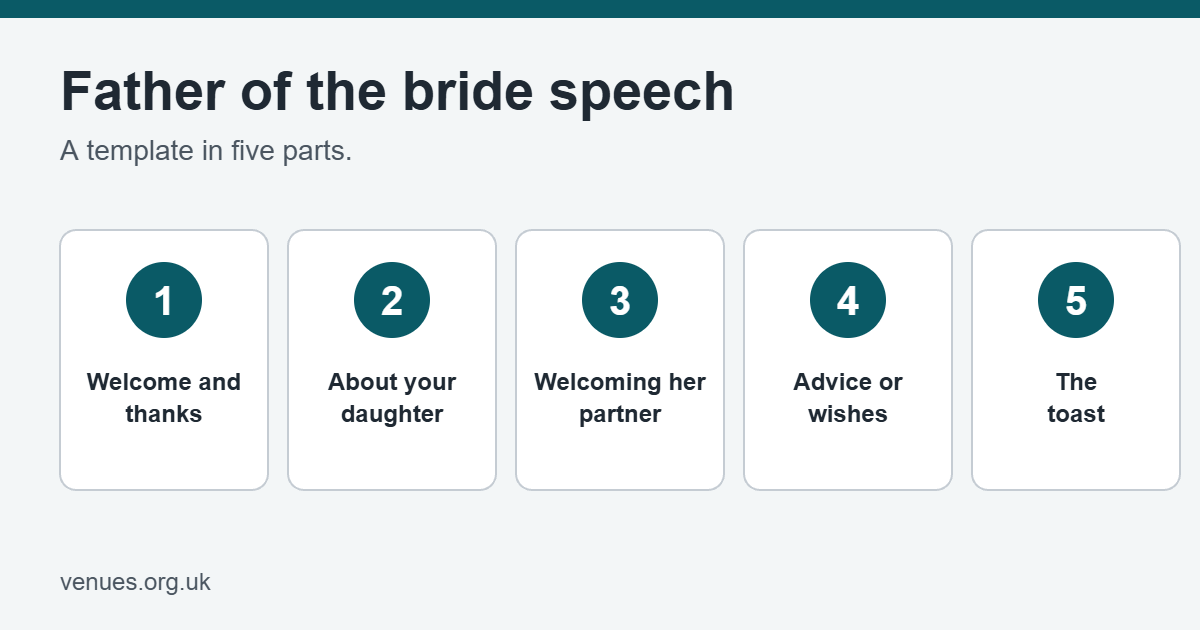
A father of the bride speech template in five parts
A father of the bride speech in the UK is usually the first speech of the reception, so it does two jobs. It opens the speeches for everyone, and it is your chance to speak about your daughter. This template keeps those jobs in a sensible order.
| Part | What it does | Share of the speech |
|---|---|---|
| 1. Welcome and thanks | Tells the room who you are, welcomes the guests on behalf of the hosts and thanks people for coming. It settles you and the audience. | About a sixth |
| 2. About your daughter | The centre of the speech. Two or three qualities, with one short story that shows them. Speak to her directly for at least one sentence. | About a third |
| 3. Welcoming her partner and their family | Says what you like about her partner and what you have seen in the two of them together. Welcomes the other family by name if you can. | About a quarter |
| 4. Advice or wishes | One or two thoughts for their marriage. Wishes are easier to get right than advice, and shorter. | About a sixth |
| 5. The toast | Asks the guests to stand if they are able and raise a glass to the couple. It tells everyone the speech has finished. | Two or three sentences |
How long should a father of the bride speech be?
Around five minutes is a good length, and anything from three to five minutes is comfortable for most rooms. This page assumes a steady pace of about 130 words a minute, which leaves room for pauses and laughter. That figure is a working assumption, not a measured average, and everyone speaks at a different speed, so time yourself reading your own speech aloud. It is the pace used for every speaking time on this page.
| Speaking time | Words at 130 a minute | Suits |
|---|---|---|
| 2 minutes | About 260 | A small wedding, a nervous speaker, or a day with many speeches |
| 3 minutes | About 390 | Most weddings where four or more people are speaking |
| 5 minutes | About 650 | The usual length when three people speak |
| 7 minutes | About 910 | A confident speaker with good stories and a patient room |
Worked example
Leave the builder on its opening settings: father of the bride, partner wording, warm and traditional, 3 minutes, all five sections. Type Emily as your daughter’s name and James as the person she is marrying. The builder gives a draft of 364 words, which is about 2 minutes 50 seconds at 130 words a minute. Adding a memory of your own will take it a little over that.
Father of the bride speech examples
These six father of the bride speech examples are complete and original. Each one follows the five parts above. The names and details are invented, so swap in your own. Speaking times are the word count divided by 130 words a minute.
1. Short and simple
130 words, about 1 minute at 130 words a minute.
Hello, everyone. I am Hannah’s dad, and I promise to be brief.
Thank you all for being here. It means a great deal to Hannah and Tom, and to our family, to have you with us.
Hannah, you have been a joy from the day you arrived. You are kind, you work hard, and you have always known how to make a room feel friendlier. I am very proud of you.
Tom, you make Hannah happy, and you have become part of our family without any effort at all. Welcome. We are lucky to have you.
I wish you both a long and happy marriage, with plenty of laughter and a lot of ordinary, contented days.
Please stand, if you are able, and raise your glasses. To Hannah and Tom.
2. Warm and traditional
306 words, about 2 minutes 20 seconds at 130 words a minute.
Good afternoon, everyone. On behalf of Susan and myself, welcome, and thank you for joining us to celebrate the marriage of our daughter Charlotte to Daniel.
Some of you have travelled a long way to be here, and it is wonderful to see so many friends and relations in one room. Thank you also to everyone who helped to make today run so smoothly.
Charlotte, you were a thoughtful child and you have become a thoughtful adult. You were the one who shared your sweets without being asked and wrote thank-you letters that ran to a second page. You worked hard at school, harder at university, and you have built a career and a circle of friends that your mother and I are very proud of. What we are proudest of is simpler than any of that. You are kind, and you are kind when nobody is watching.
Daniel, the first time you came to the house you offered to wash up, and you have kept offering ever since. We noticed. More to the point, we noticed how Charlotte is when you are around. She is relaxed, she laughs a great deal, and she is entirely herself. Susan and I could not have asked for more, and we are delighted to welcome you into the family.
To Daniel’s parents, Anne and Robert, and to all his family, thank you for the warmth you have shown Charlotte. We look forward to many more gatherings together.
Charlotte and Daniel, marriage is built on small things done often. Listen to each other. Say thank you. Make time for each other when life is busy, because that is when it matters most. If you do those things, the big things tend to look after themselves.
Everyone, please stand, if you are able, and raise your glasses. To Charlotte and Daniel.
3. Light humour
316 words, about 2 minutes 30 seconds at 130 words a minute. In this example the speaker is the father of one of two brides.
Hello, everyone. I am Martin, Sophie’s dad. For those who do not know me, I am the man who has been practising this speech in the car for three weeks. The people at the traffic lights on the ring road have heard it several times, and their feedback has been mixed.
Thank you all for coming. Looking around, I can see family, old friends, and several people I last saw when they were small enough to hide under this table.
Sophie has always known what she wanted. At six she presented me with a written proposal for a dog. It had headings. It had a section on who would do the walking, and I would like the record to show that the answer in that document was not me. We got the dog. I did the walking. I regret nothing, and I learned early that when Sophie has made a plan it is easiest to put your coat on.
She has grown into someone who is funny, loyal and very good at getting things done, and I am prouder of her than a short speech can cover.
Priya, when Sophie first told us about you, she talked for twenty minutes and I got one question in. The question was “What is she like?”, and the answer took another twenty minutes. Having got to know you, I think she undersold you. You are calm, you are generous, and you laugh at my jokes, which is a quality this family has been short of for years. Welcome. To Priya’s family, welcome too. We are delighted to be joined up with you, and I hope you like dogs.
Sophie and Priya, my advice is short. Be kind to each other, keep making plans, and when one of you produces a document with headings, the other one should put a coat on.
Please raise your glasses. To Sophie and Priya.
4. Emotional
281 words, about 2 minutes 10 seconds at 130 words a minute.
Hello, everyone, and thank you for being here. I am Grace’s father, and I have been told I am allowed one handkerchief, so I will do my best.
Grace, I remember carrying you out of the hospital and driving home slower than I have ever driven in my life. I did not feel ready. I am not sure I feel ready today either, but you have always been a step ahead of me.
I have watched you become someone remarkable. You sit with people when they are sad. You remember what matters to them. When your grandmother was ill, you were the one who visited every week and read to her, and you never once mentioned it to anyone. That is who you are, and I could not be prouder of you.
There were hard years too, and you met them with more courage than you give yourself credit for. I want you to know that I saw it.
Matthew, I worried, as fathers do, about who Grace would end up with. Then I watched you with her. You listen to her. You make her laugh when she is tired. You look at her as though you cannot quite believe your luck, and I know that feeling well, because I have had it since the day she was born. Thank you for loving her. You are part of this family now, and we are better for it.
Grace and Matthew, I hope you have a long life together and a gentle one. Hold on to each other on the difficult days. Remember how today felt.
Please stand, if you are able, and raise a glass with me. To Grace and Matthew.
5. For a small wedding
190 words, about 1 minute 30 seconds at 130 words a minute.
There are twenty of us around this table, so I do not need a microphone and I do not need to introduce myself. That is one of the nice things about a small wedding. Everyone here was chosen, and everyone here matters to Ellie and Sam.
Thank you for coming, and thank you for the part each of you has played in their lives. I can look at every face here and think of something kind you have done for them.
Ellie, you told us you wanted a day with good food, the people you love and no fuss. You have got exactly that, and it suits you. You have never needed a crowd to know your own mind. I am very proud of you, today and every day.
Sam, you have been part of our Sunday lunches for so long that I set your place without thinking. It is a pleasure to make it official. Welcome to the family.
I wish you both a happy home, a full table and many more meals like this one.
You can stay sitting down. Please raise your glasses. To Ellie and Sam.
6. For a second marriage or a blended family
267 words, about 2 minutes at 130 words a minute.
Hello, everyone. I am Rachel’s dad, and it is a great pleasure to welcome you all today.
I want to start with three very important people. Josh, Lily and Erin, you have all been brilliant today, and this is your day as much as anyone’s. Two households have become one family, and from where I am standing it looks like a very good one.
Rachel, I have always been proud of you, and I have never been prouder than I have been over the last few years. You have built a warm and happy home for Josh and Lily, you have worked hard, and you have stayed generous and funny through all of it. You deserve every bit of the happiness I can see on your face today.
Mark, you came into Rachel’s life with patience and good sense. You took time to get to know Josh and Lily, and you let them get to know you at their own speed. I noticed that, and it told me all I needed to know. You and Erin are family to us, and you have been for some time. Erin, that means you now have an extra grandad, whether you wanted one or not. I come with a shed and a biscuit tin.
Rachel and Mark, you both know that a good marriage is made on ordinary days. You know what matters, and you have chosen each other with your eyes open. I wish you, and all three children, a home full of laughter.
Please raise your glasses. To Rachel, Mark, Josh, Lily and Erin. To the whole family.
Wording for different families and speakers
The opening speech belongs to whoever the couple want to hear from. The structure stays the same. These notes cover what changes.
Stepfather of the bride
Say plainly how you came into her life and what it has meant to you. You do not need to explain the family history, and you do not need to compare yourself with anyone. If her father is also present, a short and generous mention of him works well, and it is kind to agree beforehand who says what. Example: “I came into Megan’s life when she was nine. She did not have to make room for me, and she did. I have been grateful ever since.”
Mother of the bride
A mother can give this speech alone, and nothing in it needs to change except “I am her mother”. Speak as yourself and do not present it as standing in for someone. Example: “I am Olivia’s mum, and I have waited a long time to embarrass her in front of this many people. I have decided to be kind.”
Both parents together
Share it by section so that nobody is talking over anybody. One of you gives the welcome and speaks about your daughter, the other welcomes her partner and gives the wishes, and you give the toast together. Use “we” throughout. Practise the handovers aloud, because that is where joint speeches stumble.
A brother, uncle or friend speaking in the father’s place
Say who you are and that she asked you. That is all the explanation the room needs. Speak from your own relationship with her and do not try to give the speech her father would have given. Example: “Aisha asked me to say a few words today. I have been her big brother for thirty-one years, so I have plenty of material, and I have promised to use almost none of it.”
When a parent has died
Ask the couple first whether they would like a mention and how much. Most do want one. Keep it to two or three sentences, place it early or just before the toast, and say the person’s name. Speak about what they would have enjoyed about the day so that the room can smile as well as feel the loss. Then pause, and move on. Example: “Laura’s mum, Helen, would have loved today. She would have been first on the dance floor and last off it. She is very much with us, and I know how proud she would be.” If you are speaking because her father has died, one honest line is enough: “I know how much David would have wanted to stand here. I am honoured to do it for him.”
Same-sex couples
If you are the father of one of two brides, your speech is about your daughter and her wife, and everything in the structure applies as it stands. Check which words the couple use, such as wife, partner, bride or spouse, and use those. If both sets of parents are speaking, agree who gives the general welcome so that it is said once. Toast them by name.
A father speaking at a son’s wedding
The father of the groom does not have a set place in the traditional order, and many couples now invite him to speak. Welcome the guests if nobody has done so already, speak about your son, welcome his husband, wife or partner, and toast the couple. The builder has a setting for this.
If the family is complicated
Divorced parents, new partners and people who are not on speaking terms are all normal at weddings. Thank people by name and without ranking them, keep to what is true and kind, and leave the history out. Ask your daughter to read the draft if you are unsure about any line.
Lines to borrow: openings, your daughter, her partner and toasts
Here are 84 original lines. Replace [Name] with your daughter’s name and [Partner] with the name of the person she is marrying. Change “she” and “her” if you are speaking about a son.
Opening lines
- Hello, everyone. I am [Name]’s father, and I would like to welcome you all.
- Good afternoon. For anyone I have not met yet, I am [Name]’s dad.
- On behalf of my family, welcome, and thank you for being here.
- Thank you all for coming to celebrate [Name] and [Partner] with us.
- It is a real pleasure to look around this room and see so many people who love these two.
- Some of you have travelled a long way to be here. Thank you. It means a great deal.
- I have been looking forward to this speech, and worrying about it, in roughly equal amounts.
- I will keep this short, because I know what is standing between you and the dancing.
- I have been given five minutes and one handkerchief. I intend to use both.
- I have practised this in the car so often that the dog can now do the first paragraph.
- I was told to speak from the heart. I have also written it down, in case my heart forgets.
- Before I say anything else, was that not a lovely ceremony?
- Today I have the easiest job in the room, which is to tell you how proud I am.
- I am not used to speaking in public, so please be kind and laugh where you can.
- Welcome, everyone, to what has already been one of the happiest days of my life.
- I have rewritten this speech more times than I would like to admit, and this is the version that survived.
- I would like to begin by thanking everyone who helped to make today happen.
- I have had the best job in the world for a long time now, which is being [Name]’s dad.
- I promised [Name] three things about this speech. It would be short, it would be kind, and there would be no baby photographs. I will keep all three.
- There are people missing from this room today, and we are thinking of them as we celebrate.
- Welcome, all of you. Family, friends, and friends who have been around so long that they count as family.
Lines about your daughter
- [Name], you have made me proud every day of your life, and never more than today.
- From the day you were born you knew your own mind, and I have enjoyed watching you use it.
- She is kind when it is easy and kind when it is not.
- She has always been the first to notice when somebody needs a hand.
- I remember teaching her to ride a bike. I let go of the saddle long before she knew, and she kept going.
- She was a child who asked “why” until I ran out of answers, and then went and found better ones herself.
- She makes friends easily and keeps them for decades, which tells you all you need to know.
- She has her mother’s good sense and my sense of direction, and she has done remarkably well in spite of the second one.
- Whatever she takes on, she does properly.
- She has never been afraid of hard work or of changing her mind.
- She is the person the rest of us ring when we do not know what to do.
- I thought I was teaching her. Most of the time it was the other way round.
- She has a laugh you can hear from the next room, and I hope I hear it for the rest of my life.
- [Name], you are everything I hoped you would be, and a good deal I was not clever enough to hope for.
- As a teenager she had strong views on my music, my driving and my jumpers. On reflection, she was right about the jumpers.
- She has grown from a small person who needed me into an adult I rely on.
- I look at her today and still see the child who would not go to bed until the story was finished.
- She is generous with her time, which is the most generous thing anyone can be.
- She has met every difficult day with courage and every good one with gratitude.
- Being your dad has been the great privilege of my life.
- She could organise a picnic in a thunderstorm, and everyone would enjoy it.
Welcome lines for her partner
- [Partner], welcome to the family. We are very glad to have you.
- [Partner], you have felt like one of us for a long time. Today makes it official.
- I could not have chosen a better person for [Name], and I am pleased that she did the choosing.
- From the first time we met you, it was clear how much you care about her.
- You make her laugh, you listen to her, and you are on her side. That is all I ever wanted.
- Since she met you, she has been more herself than ever.
- [Partner], you are kind, steady and patient, and you will fit in here very well.
- The first time [Name] mentioned you, she said your name four times in one sentence. I thought I had better learn it.
- You have already sat through our family quiz night and come back, which shows real commitment.
- Thank you for loving her the way you do.
- To [Partner]’s family, thank you for making [Name] so welcome.
- Two families became one larger family today, and I am delighted about it.
- [Partner], I am proud to call you family.
- Our family is one person larger today, and a good deal better for it.
- You two are a real team, and it is a pleasure to be around you.
- [Partner], you knew what this family was like and you joined anyway. We admire your courage.
- You have seen her on her best days and her hardest ones, and you have been the same person on both.
- I knew you were the right one when I saw how carefully you listen to her.
- To [Partner]’s parents, you have raised someone thoughtful and kind, and we are grateful.
- [Partner], there is always a place for you at our table.
- You bring out the best in each other, and nobody could ask for more than that.
Toasts
- Please stand, if you are able, and raise your glasses. To [Name] and [Partner].
- To [Name] and [Partner], and to a long and happy life together.
- Please join me in a toast to the happy couple.
- To love, laughter and many ordinary, contented days.
- May your home always be full of friends, and your kettle always be on.
- To [Name] and [Partner]. May you always be as happy as you are today.
- May you be each other’s first phone call with good news for the rest of your lives.
- To the two of you, and to everyone here who helped you along the way.
- Raise your glasses to two people who are better together.
- To [Name] and [Partner]. Look after each other.
- May your adventures be many and your arguments short.
- To kindness, patience and a shared sense of humour.
- To absent friends, and to the happy couple.
- To [Name] and [Partner], with all our love.
- To the newlyweds.
- To the happy couple, [Name] and [Partner].
- Here is to a full table, an open door and a long life together.
- May you never run out of things to laugh about together.
- To [Name] and [Partner], from all of us who love you.
- Please be upstanding for a toast to [Name] and [Partner].
- That is enough from me. Glasses up, everyone. To [Name] and [Partner].
Father of the bride speech jokes, and what to leave out
If you want a father of the bride speech that is funny, aim the jokes at yourself. Your own nerves, your dancing and your sense of direction are safe subjects. A funny story about your daughter works when it shows something good about her and when she has agreed to it. One or two light moments are enough. The room is on your side and wants to smile, and it does not need a comedy set.
Leave these out:
- Embarrassing stories she has not approved. Ask her, and accept the answer.
- Ex-partners, hers or anyone else’s.
- In-jokes that only four people in the room will understand.
- The cost of the wedding, or who paid for what.
- Jokes at her partner’s expense, or at the expense of their family.
- Stock jokes copied from the internet. Half the room has heard them at another wedding.
- Jokes about marriage being a burden. They are unkind to the couple and to your own spouse.
- Anything you would not say with her grandparents and the youngest guests listening, because they are.
Delivery tips for the day
- Print it large. Use 16 point type or bigger, with wide line spacing, on numbered pages or cards. The builder’s print button does this for you. A phone screen locks, dims and shakes in your hand.
- Practise aloud. Read it out at least five times, standing up, with a timer. Change any sentence you stumble over twice.
- Pause. Stop for a breath after each section and after anything that gets a laugh. A pause feels long to you and normal to the room.
- Slow down. Nerves speed everyone up. If you think you are speaking too slowly, you are probably about right.
- Look up. Look at your daughter when you speak to her, and at her partner when you welcome them.
- Hold the glass until the toast. Keep it on the table while you speak, and pick it up for the last line. Check that the guests’ glasses have been filled before you start.
- Ask about a microphone. If there is one, hold it close to your chin and keep it there.
- Go easy on the drinks beforehand. One is plenty until you have sat down again.
When does the father of the bride speech come in the order?
By custom the father of the bride speaks first, followed by the groom and then the best man. Speeches are most often held after the meal, though some couples hold them before it or between courses. Your speech ends with a toast to the couple, and the next speaker replies. The order of wedding speeches page explains the traditional order and the modern variations, and it has a running-order builder with timings. If you are looking for a best man speech template, that page also sets out what the groom’s speech and the best man’s speech usually cover.
Speeches are a reception custom and are not part of the legal ceremony. For the legal requirements of a wedding in England and Wales, see GOV.UK: plan your ceremony (opens in a new tab).
Father of the bride speech questions
How long should a father of the bride speech be?
Around five minutes is a good length, and three to five minutes suits most weddings. At an assumed pace of 130 words a minute, 3 minutes is about 390 words and 5 minutes is about 650 words. Time yourself reading it aloud, and allow a little extra for pauses and laughter.
What should a father of the bride speech include?
A father of the bride speech has five parts: a welcome and thanks to the guests, a few words about your daughter, a welcome to her partner and their family, some advice or wishes for the couple, and a toast. The section about your daughter is the longest and should include one short story.
When does the father of the bride give his speech?
By custom the father of the bride speaks first, before the groom and the best man. Speeches are most often held after the meal. The order is a custom and the couple can change it.
Who gives the speech if the father of the bride cannot or does not want to?
Anyone the couple choose can give it. A mother, stepfather, both parents together, a brother, an uncle or a close friend can all open the speeches. The bride can also speak for herself. Nobody has to give a speech at all.
Should a father of the bride speech be funny?
It can have one or two light moments, but it does not need to be funny. Jokes about yourself are the safest. Leave out embarrassing stories your daughter has not approved, ex-partners, the cost of the wedding and jokes at her partner’s expense.
How do you end a father of the bride speech?
End with a toast to the couple. Ask the guests to stand if they are able, raise your glass and say both names, for example “To Emily and James”. Then sit down.
Related tools
venues.org.uk is a directory of UK venues. These free tools help with planning.
Your father of the bride speech comes after the welcome and before the groom. You can also browse wedding venues on venues.org.uk.